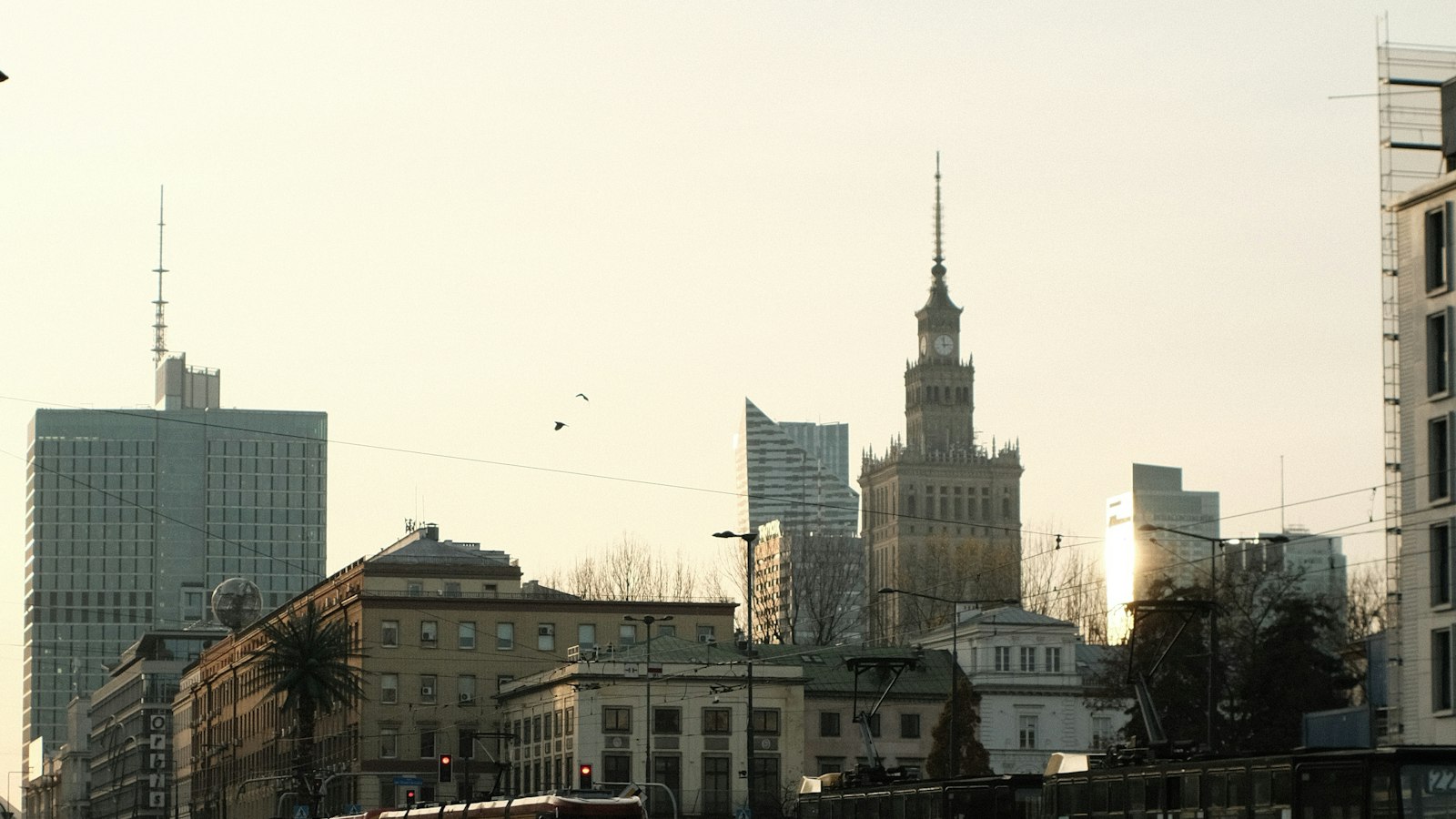
Thinking about a tech job in Warsaw? This guide covers what shapes your monthly budget as a tech worker, with official figures where they exist.
We don’t publish made-up “average rent” or “price of a coffee” numbers. Prices vary a lot by district and by month. Where no official figure is available, we tell you where to check.
Start with what you’ll take home
Your budget starts with your net salary, not the headline number in the job ad. Check whether an offer is an employment contract (gross salary) or B2B (net on invoice, before your own tax and contributions).
Our salary guide shows typical developer pay. The tax guide explains what’s deducted.
For context, the average gross monthly wage in the Mazowieckie region (Warsaw) was PLN 9,488.94 in 2024 (GUS). This covers all jobs, not only tech.
The national minimum wage in 2026 is PLN 4,806 a month (Dz.U. 2025 poz. 1242).
Prices: how fast are they rising?
Consumer prices in Poland were 3.4% higher in August 2026 than a year before. Services rose 5.6% and goods 2.5% (GUS).
Keep this in mind if you’re negotiating salary or signing a long lease.
Housing
Rent is the biggest cost for most people. It depends mostly on the district, the size of the flat and how close it is to a metro line.
How to research rents
- Look at live listings on the main rental portals for the districts you’re considering. Compare several flats of the size you want, not one.
- Check what’s included. Ask whether the rent includes building charges, heating, water, electricity and internet, or whether they’re billed separately.
- Budget for a deposit and, if you use an agency, an agency fee. Ask about both before you view.
- Check official housing data for trends. The National Bank of Poland (NBP) publishes housing market reports on nbp.pl.
Things to check before you sign
- Can you register your address there? You must register your address within 4 days of arriving (non-EU citizens) or 30 days (EU citizens), and you’ll need the owner’s confirmation or your lease (gov.pl). Our relocation checklist covers the other first steps.
- Is the lease in a language you can read? Ask for an English translation.
- How long is the notice period and what are the rules for getting your deposit back?
Consider short-term housing for your first month. It gives you time to see districts before you commit.
Getting around
Warsaw’s public transport (metro, trams, buses and city trains) is run under the city’s public transport authority, ZTM. If you choose your flat with transport in mind, you can live without a car in most central districts.
Current fares, including 30-day and 90-day tickets, are on the official Warsaw public transport website, wtp.waw.pl. Check there before you arrive, and ask your employer whether they subsidise a pass.
Health care
- Employees are covered by public health insurance through their job. Contributions come out of your salary. See the tax guide.
- If you’re not insured through work or a business, voluntary insurance with the National Health Fund (NFZ) costs at least PLN 845.67 a month for July to September 2026 (NFZ).
Check whether your offer includes private medical care, and whether it covers family members.
Build your monthly budget
Use this as a template. Fill in your own numbers from listings, your offer and your habits.
| Item | Your amount (PLN) | Where to check |
|---|---|---|
| Net salary | Your offer + tax guide | |
| Rent | Current listings in your chosen district | |
| Building charges and utilities | Ask the landlord what’s included | |
| Internet and mobile | Provider websites | |
| Public transport | wtp.waw.pl | |
| Groceries and eating out | Your own habits | |
| Health (if not covered by work) | NFZ | |
| Savings and travel home |
Keep your budget in złoty. Your salary will be paid in PLN, and exchange rates move.
What about other cities?
Kraków and Wrocław are also big tech hubs. Local wages are lower than in Warsaw. In 2024, the average gross wage was PLN 8,249.31 in Małopolskie (Kraków) and PLN 8,359.59 in Dolnośląskie (Wrocław), against PLN 9,488.94 in Mazowieckie (GUS). Tech salaries don’t always fall by the same amount, so compare offers city by city.
Browse jobs in Warsaw, Kraków and Wrocław, or look at remote jobs if you’d like to choose your city yourself.
Frequently asked questions
How much is rent in Warsaw?
We don’t publish an average rent, because prices vary a lot by district, flat size, distance to a metro line and month. Compare several live listings on the main rental portals, check whether building charges and utilities are included, and budget for a deposit and any agency fee. The National Bank of Poland publishes housing market reports.
Are wages lower in Kraków and Wrocław than in Warsaw?
Yes, on average across all jobs. In 2024, the average gross wage was PLN 9,488.94 in Mazowieckie (Warsaw), PLN 8,359.59 in Dolnośląskie (Wrocław) and PLN 8,249.31 in Małopolskie (Kraków). Tech salaries don’t always fall by the same amount, so compare offers city by city and check local rents too.
Can I live in Warsaw without a car?
Yes, in most central districts, if you choose your flat with transport in mind. Warsaw’s metro, trams, buses and city trains run under the city’s public transport authority, ZTM. Current fares, including 30-day and 90-day tickets, are on wtp.waw.pl. Ask your employer whether they subsidise a pass.
How much is health insurance in Poland if I’m not employed?
If you’re not insured through work or a business, voluntary insurance with the National Health Fund (NFZ) costs at least PLN 845.67 a month for July to September 2026. That figure is set for a specific period, so check NFZ for the current rate. Employees are covered through their job, with contributions taken from their salary.
How fast are prices rising in Poland?
Consumer prices in Poland were 3.4% higher in August 2026 than a year earlier, according to Statistics Poland (GUS). Services rose faster, by 5.6%, than goods, at 2.5%. These are national figures, not Warsaw-specific ones. Keep them in mind when you negotiate salary or sign a long lease.